
VidMate
Free YouTube video & music downloader

ACTOR
Ken TakakuraKiichi NakaiShinobu TerajimaKen Nakamoto
DIRECTOR
Yimou Zhang
SYNOPSICS
Qian li zou dan qi (2005) is a Mandarin,Japanese movie. Yimou Zhang has directed this movie. Ken Takakura,Kiichi Nakai,Shinobu Terajima,Ken Nakamoto are the starring of this movie. It was released in 2005. Qian li zou dan qi (2005) is considered one of the best Drama movie in India and around the world.
More
Qian li zou dan qi (2005) Trailers
 Victoria Watts - A Thousand Miles Between (sneak peek trailer)
 The Brothers Grimm 2005) Trailer Movie
 Riding Alone for Thousands of Miles - Trailer
 Offside Trailer
 TRAILER A Journey of a Thousand Miles starts with one single step
 FOR THOUSANDS OF MILES - Official Trailer
 Riding Alone For Thousands Of Miles Trailer
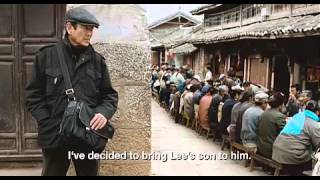 Riding Alone for Thousands of Miles Trailer (2005)
Same Actors





Qian li zou dan qi (2005) Reviews
The Ride of a Lifetime from Zhang Yimou
Good films depict feelings truthfully; with great works of art, you experience emotions deep within yourself. Zhang Yimou's "Riding Alone for Thousands of Miles" is not only a three-hankie movie, it may leave you with a sense of being changed, of being connected to others in new ways. It is that powerful, that important a work. "Only connect" - E.M. Forster's imperative for creating ties - is at the heart of Zhang's new film, but with a twist. Takata, the central character, is an elderly Japanese, seemingly unconnected to anyone, a man with a frozen face and heart, long estranged from his only son, who has now fallen gravely ill. Ken Takakura, one of the most majestic actors alive (an ideal - perhaps the only - Lear around), is Takata, his uncommunicative, stony presence compelling attention and generating a mix of apprehension and pity. Takata's journey to China's Yunnan province to complete his son's filming of the legendary song "Qian li zou dan qi," that gave the film its title, is full of twists and turns. Zhang tells the story with honesty, integrity, and Parsifal's "wisdom through compassion." In a brilliant stroke, Zhang opens and closes the film with the same scene - Takata, motionless, gazing over the confluence of gray sea and sky - but he, along with the audience, is in a completely different place, the unchanged exterior masking a person richly transformed by daring, risk-taking humanity. Zhang, a master of producing a variety of genres and styles, put everything into this work (except the wushu grandeur of "Hero" and the upcoming "Curse of the Golden Flower") - the broad sweep of "Raise the Red Lantern," the chamber music of "The Road Home," the joyful melodrama of "Happy Times," and a dozen other works. "Riding Alone" is adventure, psychological drama, a "quest film," unveiling spectacular vistas and the deep divisions/underlying connections between individuals and civilizations. And yet, through all this, "Riding Alone" is all of one piece, a grand novel in tightly connected (but ever-surprising) chapters, a 19th century literary saga in a 21st century setting. If the film were presented in a series of silent close-ups of Takakura, it would be glorious enough, but the bonus is an army of non-professional actors, in addition to the magnificent Shinobu Terajima as Takata's daughter-in-law; Qiu Lin as Lingo, the would-be interpreter; Jiang Wen as Jasmine, the accomplished translator; Yang Zhenbo as Yang Yang, an amazing child star in a pivotal role; and Chinese-opera star Li Jiamin as himself. If you're looking for a detailed story line, you will not find it here. Why would you deny yourself the pleasure of being taken along on a superb, heartwarming ride of surprise and discovery?
A journey into the heart of China
A young Japanese film maker is in hospital in Tokyo. His estranged father tries to visit, but the son refuses to see him. So, as a gesture of reconciliation, the father decides to go to China to complete the filming of a Chinese opera, called "Riding Alone for Thousands of Miles," which the son was working on but unable to finish. But the master singer whom the son was most interested in filming is now in jail, so official permission must be granted. And then the singer has a breakdown because he wants to see his own young son who is way off in the country somewhere. So the Japanese father now has to travel distances to find the son of the singer. A strong and beautiful film as one would expect from master director Yinou Zhang, it is a tale of one man's journey both into the world and into himself. In a way, it's a road movie, but there's more than one kind of road involved. Unlike his more dramatic fantasies, this is a quiet and haunting story, filled with stunning images from the hidden heart of China. Highly recommended.
Big thumb up
Thankfully Zhang, Yimou is back to make another deeply moved and typical "Zhang's Style" movie and it is wise for him to stop producing further martial art films. Ken Takakura is acting as Takada, a Japanese fishman whose son is diagnosed incurable disease but refuses to see him for the past unsolvable conflicts between them. Following the clue left on the video tape made by the son, Takada decides to travel thousands of miles from Japan to Li Jiang (Beautiful River) of Yun'nan Province in China, to complete his son's unfinished wish - to shoot a local drama played by local artist Li, Jianmin. After he arrived, a series of unexpected difficulties and events happened between him and local tour guide Qiu, Lin, love child Yangyang and opera actor Li, Jiamin among the other local residents, lead Takada to deeply think and comprehend the relationship between him and his son, and during this process his son finally forgive him from the past. Audience can not only enjoy the familiar rural scene brought by Zhang, Yimou, but also the superb genuine performances brought by those actors who are just acting with their real names(and Zhang has done this before in previous movies) apart from Ken Takakura. The dialogues are superb, they can be amused, grieved, touched and thoughtful. It is a rare movie that I can't wait to give my thumb up half-way before the end, and a must-see film can make you smile and giggle with the tears and weeps.
Getting Human
Getting into the human equation and away from acrobatic flying daggers, director Yimou Zhang spins solid gold in his latest film, RIDING ALONE FOR THOUSANDS OF MILES. Set against the stunningly picturesque Yunnan Province in southwestern China, Gou-ichi Takata (Ken Takakura) leaves his beloved Japanese fishing village to travel thousands of miles and finish video recording a famous Chinese folk opera for his dying son. Mr. Takata and his son have become distant since the death of Mr. Takata's wife, not speaking to one another for years. When word comes to him that his son, Ken-ichi, is in the hospital, Mr. Takata races to the city only to be rebuffed by his son's bitterness. Mr. Takata never sees his Ken-ichi, but his son's wife, Rie (Shinobu Terajima), tells Mr. Takata an interesting story about his love of Chinese folk dancing. She hands him an unfinished tape of Ken-ichi's work and, after watching it, Mr. Takata decides to finish the recording. "Not being good with people," Mr. Takata immediately encounters problems when he enters China. But he learns quickly, and finds humility within himself in order to finish the tape. Mr. Takata knew that his son wanted to film one particular opera (also called Riding Alone For Thousands of Miles) sung by one particular Chinese man named Li. But Li is in prison after stabbing a man. Getting permission to film Li performing the folk dance from the government higher-ups becomes one of Mr. Takata's earliest obstacles. Then, after gaining access, Mr. Li has a meltdown, thinking about his own distant son. Emotional beyond repair, Mr. Li is unable to dance for Mr. Takata. So Mr. Takata leaves to come back another day ...but an idea is sparked in his head. Mr. Takata goes to "The Stone Village" to see if he can convince Mr. Li's five-year-old son to come back with him to the prison so that he can visit. What follows is one of the most emotionally impacting moments in Chinese film history. Unable to be close to his own son, Mr. Takata transfers much of his emotional heft onto young Yang Yang (Mr. Li's son), and audiences will no doubt spill plenty of tears as this happens. The beauty of the surrounding countryside in the Yunnan Province is an awesome spectacle to behold; a backdrop that towers in all its majesty. Ken Takakura deserves Oscar mention for his quiet yet powerful (and heartbreaking) role as the conflicted and determined Mr. Takata. All of the other actors are not actors, though. They are ordinary people picked by the director for their appearances and mannerisms; excellently done by the way. There's little doubt most will know that none of them have acting experience unless DVD watchers click on the extra features. A brilliantly done foreign film that proves director Yimou Zhang isn't just an action freak.
A Wonderful Journey to Understanding and Redemption
In a village of fishermen in Japan, Takata (Ken Takakura) misses his son Kenichi, to whom he has been estranged for many years. When his daughter-in-law Rie (Shinobu Terajima) tells him that Kenichi is sick in the hospital, she suggests Takata to come to Tokyo to visit his son in the hospital where he would have the chance to retie the relationship. However, Kenichi refuses to receive his father in his room, and Rie gives a videotape to Takata to know about the work of his son. Once at home, Takata sees a documentary in the remote village Lijiang, in the province of Younnan, about the passion of Kenichi, the Chinese opera, where the lead singer Li Jiamin (Jiamin Li) promises to sing an important folk opera on the next year. When Rie calls Takata to tell that her husband has a terminal liver cancer, Takata decides to travel to Lijiang to shoot Li Jiamin singing the opera to give to Kenichi. "Qian Li Zou Dan Qi" is a magnificent movie about fathers and sons in a wonderful journey to understanding and redemption that will certainly bring tears and smiles to the viewer. The screenplay perfectly discloses in an adequate pace the touching and heartbreaking story of a man that tries reconciliation with his son filming the opera in China and finally understands the feelings of his son. It is also a story about lost chances in life to be close to those we love since people usually forget that time is irreversible and life is unique. The cinematography is amazing, as usual in Yimou Zhang movies. Ken Takakura gives a top-notch performance supported by the excellent acting of a few professional actors and actresses and an amateurish cast. The music score is very peaceful and beautiful. I have just included this gem in the list of my favorite movies ever. My vote is nine. Title (Brazil): "Um Longo Caminho" ("A Long Way")